MYCRANE WORLD
Join the Future of Cranes & Heavy Equipment Trading
How Pick and Carry Cranes Improve Efficiency in Industrial Sites
Due to ever-increasing pressure to raise productivity with no expansion in their footprints, warehouses, manufacturing plants, and industrial facilities have never been in greater need of versatile and compact lifting solutions. This is where versatile, compact lifting solutions-known as pick and carry cranes-successfully revolutionize material handling at every industrial site around the world.These compact industrial cranes represent a leap in the evolution of mobile cranes, marrying the finest qualities of classic mobile cranes with the singular capacity for lifting loads while in motion. As businesses seek small-space lifting solutions that do not sacrifice an ounce of power or versatility, the pick and carry crane represents the gold standard in warehousing, material handling, and industrial operations.
Understanding Pick and Carry Cranes: Compact Powerhouses

This class of mobile crane is specially designed for heavy lifting, juggling, and placing the load with precision without the use of stabilizers or outriggers. Unlike other usual versions of mobile cranes, which take hours for the setup process, compact industrial cranes immediately set up their operations once they reach the work site. The defining characteristic of these cranes is their ability to pick a load and carry it to another location while keeping it suspended, and this makes them invaluable within an industrial setting for efficiency in regard to space utilization.
Most of them are fitted with a telescopic boom on a compact wheeled chassis, having lifting capability starting from 2 tonnes to 55 tonnes depending on the model. The most impressive feature of the pick and carry cranes is their compact dimensions; some models can go through a regular doorway without losing much in the way of lifting capacity. With compact dimensions combined with considerable lifting ability, they turn out to be indispensable for material handling in the warehouses where the use of conventional cranes is impossible due to various limitations like space constraints.
The concept of pick-and-carry cranes came into existence in the 1980s when, for the first time, the industry required such mobile lifting equipment that could operate efficiently within the confinements of congested spaces. Since then, technological development has made them sophisticated pieces of equipment with hydraulic controls, multiple boom configurations, and increasingly electric powertrains for zero emissions in indoor applications.
Why Pick and Carry Cranes Are Indispensable Investments for Warehouses and Small Workspaces
The industrial sector is faced with the challenge of working out the need for material handling efficiently in compact environments, considering the complicated operations and a high value on space. Large overhead cranes are powerful yet require a huge investment in infrastructure, besides using up much-needed vertical space. Larger mobile cranes are versatile but mostly unable to navigate narrow aisles and small areas typical of most modern warehouses and manufacturing facilities.
Following are some of the advantages that make them indispensable in tight industrial environments: solve such challenges.
Excellent manoeuvrability in confined space
The compact footprint of the pick and carry crane allows them to go further into spaces where bigger equipment just cannot operate. With widths as narrow as 935mm on smaller models, these cranes are able to pass through a standard doorway, a tight warehouse aisle, and even the most congested of production floors. This tight turning radius, combined with highly responsive steering systems, enables the operators to set loads with precision in areas that no conventional lifting equipment could access.
That does not stop at merely moving horizontally, pick and carry cranes can work under low ceilings and overhead obstacles-a critical advantage in warehouses that have limited headroom or multi-level facilities where ceiling heights inhibit traditional crane operations. Driving under the roof structure, existing crane systems, and other overhead obstructions means there are options for lifting throughout an entire facility.
ORI/Operational Readiness Immediately
The most important advantage with the pick and carry crane is that no setup time of any kind is required. Mobile cranes have always had to deploy outriggers and/or stabilizers before any kind of lifting operation, be it day or night. This can be a long time, depending on site conditions-up to 30 minutes or more than an hour, depending on the size of the crane. In contrast, the pick and carry crane can lift at any time after it arrives on site.
This immediate operational capability translates directly into productivity gains. On a manufacturing floor where thousands of dollars per hour may be the cost due to machine downtime, quick repositioning of the equipment or the replacement of components without long delays in setting up cranes saves huge sums. Similarly, in warehouses dealing with shipments where speed is necessary, fast deployment of lifting equipment secures loading and unloading operations at the pace that scheduling dictates.
Range of applications can be used for versatility.
A modern pick and carry crane has many different lifting configurations, thus making it very versatile and suitable to fulfill many different operational requirements. The conventional hook block allows conventional lifting, while many options of specialty attachments can extend the range of capabilities. The machinery hook mounted at the tip of the boom (also called a rhino hook) enables picking in close overhead quarters where the standard hook block cannot fit. Sliding hooks attached underneath the boom enable operators to move materials under low doorways and through access points with very little headroom.
This versatility carries right through to specialized applications thanks to interchangeable attachments. The glass and cladding lifters transform the pick and carry crane into a precision glazing installation tool, while the telehandler forks transform the machine into an elevated material handler. Smooth, flat materials can be handled in safety using vacuum lifting systems. In this way, a single crane can assume several functions across an industrial facility, reducing investment in equipment and thereby simplifying fleet management.
Improved Safety Features
Safety considerations in industrial use are foregrounded; on the other hand, in pick-and-carry cranes, while features that will help in protecting operators and other personnel working around them are implemented. The most modern ones boast anti-toppling systems with sensors that monitor stability in real time and can even self-restrict operations automatically upon detection of unsafe conditions. Audible-visual warning systems alert the operator and the rest of the personnel about any potential hazard.
Therein lies the fact that the design inherently creates a low center of gravity, which favors stability during the lifting process. This is in comparison to those taller mobile cranes that become top-heavy; this manages better balance-even with a load at or near maximum capacity. Overload protection systems prevent an operator from exceeding safe working limits by automatically restricting boom extension or load lifting when weight thresholds are approached.
Also, the major trip hazards are removed without deployed outriggers on site. In a busy industrial environment, personnel and forklifts along with other equipment, are in continuous motion. The absence of deployed outriggers will mean a much safer workspace, which is easier to navigate.
Mobile Cranes versus Tower Cranes: Which Is Best on an Industrial Site?
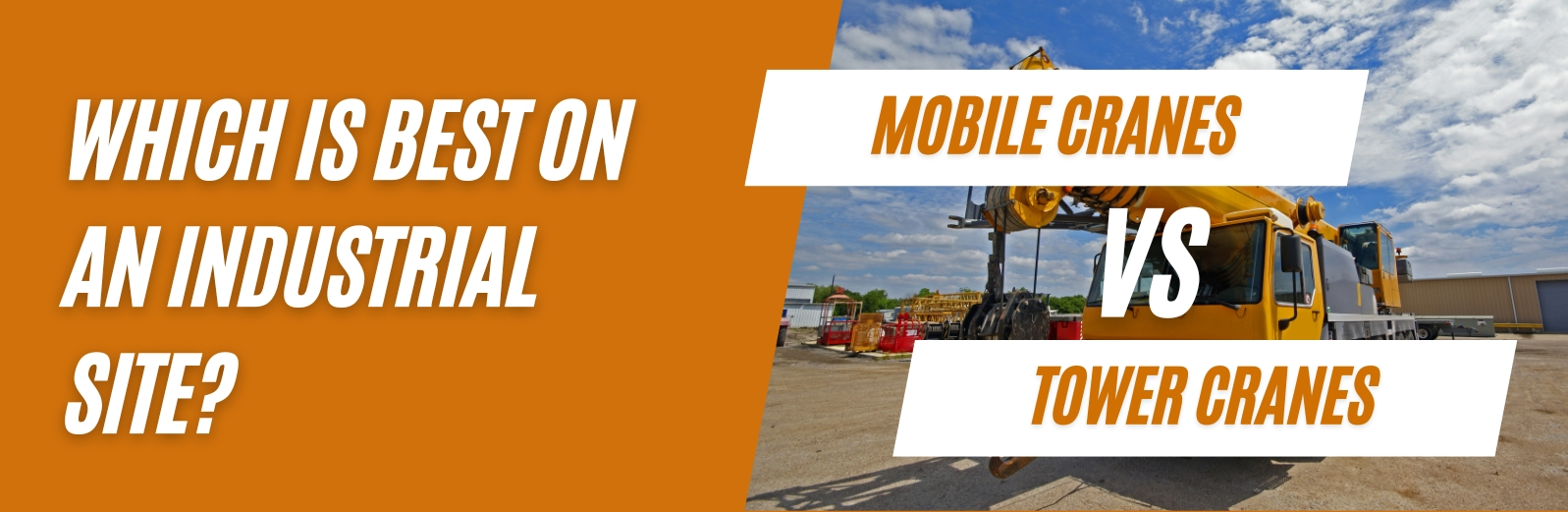
One of the central questions which virtually any project manager asks when planning lifting operations at industrial facilities sounds like this: should we deploy mobile cranes or invest in tower cranes? Each of these crane types has a vital role in construction and industry in general; however, the advantages of each will be important to understand in highly optimizing equipment selection for certain applications.
Benefits of Mobile Cranes at Industrial Sites
The advantages of mobile cranes, even of the pick and carry type, are so evident that they become particularly suitable in industrial-type sites:
Flexibility and Adaptability: The mere fact that they are mobile means that they can easily be relocated any time there is a change in operational needs to serve different areas of the facility. That kind of mobility allows for use in many locations, as opposed to being fixed at one single spot. Clearly, such flexibility is invaluable in these dynamic industrial settings where production layout changes occur with such frequency.
Lower Infrastructure Requirements: For the same reason that tower cranes require heavy foundation and structural support, mobile cranes remain free from building infrastructures. This independence removes requirements for expensive works aimed at preparing the foundation and reinforcing structures, hence substantially cutting the initial investment and time of installation.
Cost-effectiveness for variable workloads: many facilities with intermittent lifting needs find it cost-effective to rent mobile cranes rather than install permanent tower cranes. Equipment brought in only when needed avoids ongoing maintenance costs and allows capital release to core business operations.
Fast Deployment: Whereas mobile cranes can be delivered on site and begin working in a couple of hours, the tower ones take several days, and sometimes even weeks to assemble. Actually, fast deployment makes mobile cranes irreplaceable in urgent situations, which in fact happen most often.
Tower Crane vs. Mobile Crane: Which one really reigns supreme in industrial usage?
Although tower cranes boast of quite a few advantages in a lot of conditions, especially on big building projects that demand extended reach and continuous heavy lifting, there are quite a few limitations as to the adaptation of such cranes to an industrial setting.
Limited Mobility: Tower cranes are installed and stay in one place during their entire operational life. This creates a big inefficiency in industrial facilities where the production area shifts or many places require lifting support.
Complexity of installation: A Tower crane is a long-term commitment; it requires lots of planning, many times involving heavy foundation work, and may require building permits. The installation upsets ongoing operations-the type of downtimes that industrial facilities cannot afford to have.
Space Requirements: The tower cranes essentially call for large clearances in an open area for the rotation of the boom and handling of the load. They cannot be used practically for operations within already existing industrial sites or areas that may have existing structures, overhead utilities, or areas bounded by confined spaces.
Higher fixed costs are presumed to be an investment in tower crane rentals and installation, their eventual removal being a high fixed cost, irrespective of the level of utilization. This cost structure may be uneconomic in the facilities in industry with variable lifting needs.
While most of the industrial applications can have better value in terms of maneuverability, speed deployment, and operational flexibility for better alignment with the dynamic nature of the industrial operations, it is those related to warehouse material handling, equipment maintenance, or at the production line that must benefit more significantly from mobile lifting equipment and specifically from pick and carry cranes.
Best Crane for Industrial Environment Construction Projects
A number of factors in the choice of an appropriate crane meet the needs of the construction projects in industrial settings. Even on large building sites, tower cranes are applicable, while for many industrial construction and renovation applications, the requirements are better addressed by mobile cranes.
Project Requirements Assessment
The optimum selection process of the crane starts with the establishment of the project parameters.
Load Characteristics: Weight, size, and center of gravity should be recorded for all loads to be lifted. Pick and carry cranes are at their best lifting loads of 55 tonnes or less-that covers the vast majority of industrial equipment and material.
Site Constraints: Check on space availability, ceiling height, width of doorways, and floor loading capacity. Sites with limited access or small measurements are suitable for small industrial cranes, capable of passing through tiny spaces.
Duration and Frequency: Determine whether the lifting needs of the task are constant or occasional. For projects with infrequent lifting needs, the rental of mobile cranes is way cheaper compared to permanent installation.
Operational Timeline: Equipment that will eliminate set-up delays and is easily redeployed as the work progresses can be a decided advantage on projects with aggressive schedules.
Small-Space Lifting Solutions for Industrial Projects
Industrial construction is very often executed in operational facilities whose business cannot be shut down. This is a very real constraint that makes small-space lifting solutions not just preferred but also necessary. Pick and carry cranes address the challenges of the above mechanisms.
Minimum Footprint Compact dimensions permit operation in areas between production equipment and within narrow corridors and tight work cells where larger equipment will not fit.
Less disruption: areas around a lift remain accessible while lifting operations are in progress and other work may continue side by side.
Indoor capability: Because electric units eliminate exhaust emissions, they are safe to operate inside an enclosed area where diesel-powered equipment would not be permitted. This capability is most important in the cleanroom environment and in other sensitive industrial applications related to food processing.
Precise positioning: The placing of loads with millimeter accuracy, possible with hydraulic steering and responsive controls, is critical either in placing equipment with close tolerances or positioning components onto production lines.
Maximizing Efficiency in Operations with Pick and Carry Cranes
Their worth is more than that of basic lifting. Rather, appropriately embedded into industrial operations, these machines are force multipliers, amplifying productivity along several dimensions.
Reduced Equipment Downtime
In fact, manufacturing plants work under immense pressure for minimum machinery downtime. When the production machinery requires maintenance, replacement of parts, or even relocation, just about every minute of idle time amounts to money lost. Pick and carry cranes hasten such operations due to their availability and rapidity to get a job done.
Whereas conventional methods of performing lifting operations many times require several-day advance notification of crane rentals, scheduling around production and production schedules, and time for setup, the immediate availability of a pick and carry crane either on site or through quick rental deployment means that facilities can immediately address maintenance needs. What could have been hours of waiting for a crane to show up and set up is repaired in a matter of minutes with the immediate availability of a pick and carry crane.
The possibility of making "pick and carry" operations keeps the loads suspended, hence making multi-stage operations run faster. For instance, if the machinery to be changed must move across various areas, the crane can keep the load while it moves around the facility. As such, it saves time that would be lost in lowering, re-positioning, and re-raising equipment.
Optimization of Material Handling in a Warehouse
The warehouses have to balance the needs between maximum storage density and efficient material flow. Pick and carry cranes contribute to both objectives: because of their compact dimensions, they are operable within standard aisle widths and allow high-density storage configurations far beyond the reach of other larger equipment.
Pick and carry cranes, then, provide a practical alternative to gantries or overhead cranes for oversized or heavy items other than those beyond the capacity of forklifts. Unlike a fixed gantry installation, mobile cranes have access to any area of the warehouse. To some warehouses, particularly to those that must handle a diverse product mix where product storage locations change with great frequency, the capability of doing so becomes extremely important.
The added advantages to this are that the pick and carry crane provides precision capability in terms of lifting. Fragile items, or those of high value, benefit most from controlled lifting and placement as opposed to the sometimes harsh handling with forklifts. Eventually, this pays off in substantial savings over time due to better maintenance of product condition and improved customer satisfaction.
Supporting Lean Manufacturing Principles
Lean manufacturing concerns waste elimination, but of different types: excess inventory, extra motions, waiting, and processing.. Pick and carry cranes support lean on a number of fronts:
Waste reduction in transportation: This is due to the fact that it cuts down on handling steps and temporary storage through the capability to move materials right from points of delivery to points of use.
The pick and carry cranes are one form of support for flexible layouts when manufacturers reconfigure the production cells and equipment layouts by aiming for optimum flow.
Quick Changeover Capability: The fact that a manufacturing facility can change over large equipment in such a very short time becomes a big plus in multi-product line environments. Pick and carry cranes speed up the pace of die changes, fixture replacements, and tooling swaps that are required to enable shorter production runs and reduced inventory levels.
Right-Sized Equipment: Multiple capacity models mean facilities can match crane capability to actual requirements, not overspecify equipment "just in case," thereby saving unnecessary capital expenditure.
Industrial Applications: Where Pick and Carry Cranes Shine
Such versatility means that pick and carry cranes are applied to a wide array of industrial uses. Naturally, this familiarity with various application scenarios facilitates an understanding by organizations of those areas within their operations where opportunities for efficiency gains exist.
Manufacturing and Assembly Operations
Manufacturing facilities perhaps are the most natural application environment for pick and carry cranes. The support of the production line calls for frequent lifting of components, raw materials, and finished products in areas where the installation of fixed cranes is highly impracticable.
Pick and carry cranes also find applications in automotive manufacturing: placing of engines, placing body panels, feeding the lines. Manipulation within the workstations and lifting the components into place enable smooth and efficient production. Since these production lines also entail model changeovers, these cranes provide the ability to quickly change over the tooling and fixtures that minimize losses in production.
Applications of the electric pick and carry cranes find their scope increasingly during the installation and maintenance of equipment in electronic manufacturing, especially those conducted in cleanroom environments. Its zero-emission operating feature combined with compact design ensures access to controlled environments without compromising on air quality standards.
Warehouse and Distribution Centres
Modern distribution centers operate under high pressure to meet their set targets, satisfying orders within the shortest time while managing large inventories. This is met by the pick-and-carry cranes, which handle oversized items efficiently, unload containers, and access high-bay storage facilities.
Cold storage facilities take huge advantage of the enclosed cab options that many of the pick and carry cranes offer, keeping operators safe from the extreme temperatures while maintaining productivity in these frozen and refrigerated environments. Compact design allows navigating down insulated corridors and between high-density racking systems.
Cross-dock operations involve speedy material transit where the shipment receipt is directly sent to outbound transportation within a very short time. Picking and carrying cranes accelerate the process of sorting and loading, hence reducing the dwell times and improving the output of the facility.
Industrial Maintenance and Plant Services
Pick and carry cranes will be deployed to the power generation facilities in tasks including turbine maintenance, transformer servicing, and auxiliary equipment repair. A very important feature of the machinery is reaching machinery installed in areas designated for operation and not for ease of access. Electrical versions can also be utilized inside the turbine halls and control rooms, where the exhaust would be an issue.
Chemical and petrochemical plants have the unique challenge of marrying heavy machinery with hazardous environments. Pick and carry cranes, with appropriate safety features, enable pump replacements, reactor maintenance, and piping work in spaces inaccessible to larger cranes. The quick deployment capability means maintenance can be done during scheduled shutdown windows without extended crane setup eating into the available work time.
Food and beverage processing plants have to clean and sanitize the equipment quite often. The pick-and-carry cranes are capable of picking up and reinstalling machinery for processing to allow deep cleaning to higher levels of hygiene. Some models offer tires that will not leave marks, along with stainless steel finishes, to avoid any contamination of the product and maintain sanitary conditions.
Renting vs Buying Pick and Carry Cranes through MYCRANE
Every organization that has a need for lifting faces decisions on whether to buy the equipment or utilize rental solutions, which makes a significant impact on both operational flexibility and financial performance. Knowing which considerations favor one approach over another greatly optimizes this critical choice.
When Crane Rental Makes Sense
The rent of the pick and carry cranes through a network, such as provided by MYCRANE, will represent optimum value on a wide range of industrial applications. There are circumstances under which rental is particularly well-suited:
The variable workload means that the facility with irregular lifting needs avoids investing in idle equipment via rental. Take for example, as opposed to investing in cranes which can be unused during lean months, an organization will only have use of the equipment when the need actually arises and, therefore, changes what would have been fixed costs into variable expenses reflecting actual usage of equipment.
Project-based operations have defined timelines, and construction, renovation, and reconfiguration projects will also have a defined timeline. Rentals for the term of the project eliminates residual equipment upon completion-thereby avoiding long-term storage and maintenance responsibilities.
Technology Trial: Organisations that can eventually buy a permanent crane can also rent various models in order to test the performance characteristics and capacity requirements of each model before the purchase. This trial period ensures that what is purchased will best match up to the needs of the operation.
Preserves Capital: Renting frees capital for core investment in the business and yet makes equipment available when needed. In this respect, improvement in cash flow and a lesser impact on the balance sheet are particularly beneficial to growing organizations that strive to expand operations without tying their capital into ownership of equipment.
Handling maintenance has become simpler since most rental agreements cover maintenance costs, and hence there is no special need for technicians, inventories of spare parts, or the scheduling of service. All this is particularly important to small-scale operations, which cannot afford to have any particular department allotted to maintenance.
Reasons to Buy with MYCRANE
It can be more economical in terms of ownership if your organization has ongoing high-volume lifting needs over a longer period. The MYCRANE platform enables informed purchasing decisions by:
Fleet Comparison: The availability of several manufacturers and models provides direct comparison of specifications, capabilities, and prices. This level of transparency will enable the organization to choose only those pieces of equipment that precisely meet the needs without overpaying for capacity or features not required.
Verified Suppliers: MYCRANE verification of suppliers means credibility in the quality of equipment and documentation being valid. Buyers of its service will believe in the investment, usually through assured suppliers with track records.
Specification Support: The company has a facility called Crane Selector, which assists an organization in selecting the right capacity based on what exactly needs to be done. This recommendation avoids under-specification that might result in a lack of adequate capability, and over-specification that may lead to extra expenses.
Full support: MYCRANE goes way beyond the very transaction, including access to engineering services, transportation logistics, and ongoing technical support. It is an eco-system approach-one that addresses the needs of the organization throughout the full life-cycle of equipment.
Financing Options: MYCRANE facilitates equipment financing options, which are made available as options to spread capital costs over time, and the company facilitates these in cooperation with financial service providers to allow ownership benefits.
The ideal MYCRANE's Platform for Crane Solutions
Whereas MYCRANE simplifies what has traditionally been a fragmented process of crane renting and buying, the major features of the MYCRANE platform for organizations include:
Centralized Request Management: For example, organizations would not have to make calls to various suppliers but instead send only one comprehensive request, which qualified providers in their area would pick up. With this, market coverage is guaranteed plus the best price.
Realtime quotation comparison: While the request is responded to by the suppliers, it gives the user an opportunity to make a side-by-side comparison through the dashboard. Detailed breakdowns of mobilization costs, day rates, and inclusions of services let users make informed decisions based on price and value.
By nature, competitive bidding ensures that market rates are realized without the usual opacity in crane procurement. Thus, an organization is assured to enter the market with confidence that it realizes fair value, whether for the first time or as a seasoned professional.
24/7 Support: The MYCRANE support team guides the whole process, right from the definition of the requirement to the final execution of the contract.Such advice goes a long way in assisting an organization that is either new in the operations of crane rentals or is facing unique operational challenges.
Documentation Management: The platform consolidates project documentation, communications, and contractual information in one easily accessible location. This makes such an organization easy for compliance, audit trails, and any future referencing.
MYCRANE delivers unparalleled access to the global crane rental and sales markets, enabling organizations seeking compact industrial cranes that can help optimize space utilization and operational efficiency. Whether this is a short-term rental for the purpose of supporting a particular project or it is to be outright purchased with the intention of building in-house lifting capabilities, the platform enables informed decisions through complete market coverage supported by expert advice.
Future of Pick and Carry Cranes in Industrial Operations
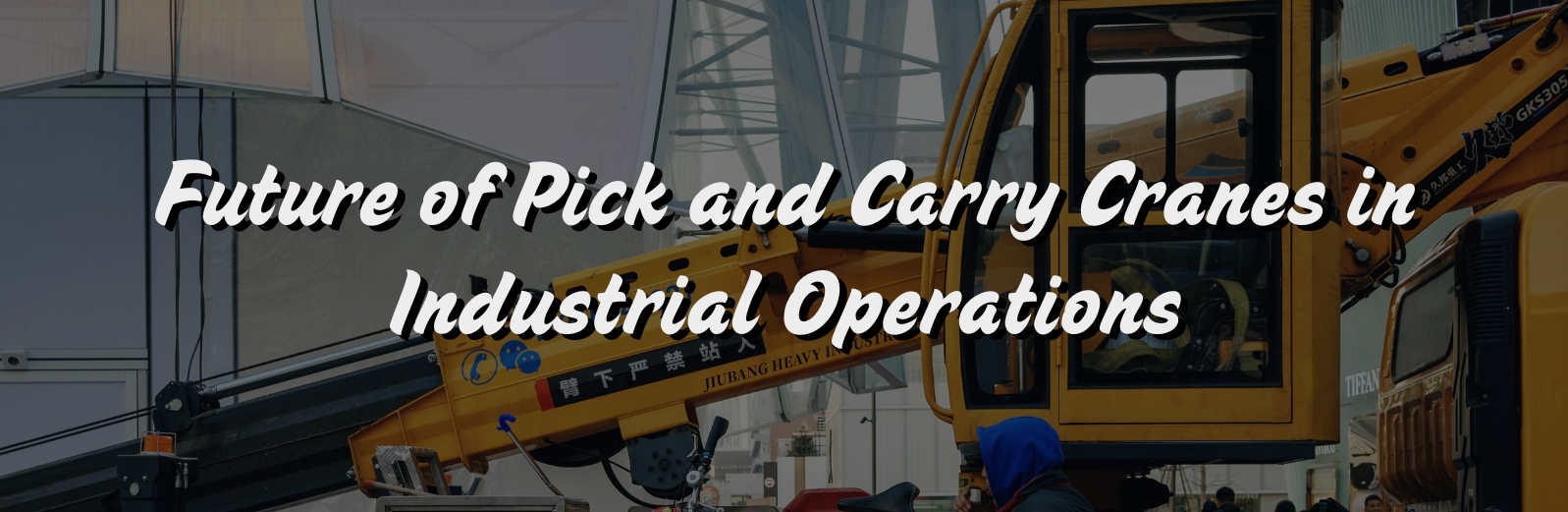
The way the pick and carry cranes operate will definitely change, as industrial operations continue to progress in the direction of more automation, sustainability, and efficiency. These are the trends that help an organization make a decision on the equipment that would be in tune with the emerging technology.
Electric and Hybrid Powertrains
In fact, this trend is now strengthened by environmental regulations, sustainability commitments, and extra advantages in operation. Most of the modern electric pick-and-carry cranes have matched or outdone their diesel counterparts while at the same time doing away with noxious fumes, noise pollution, and operating costs.
Active improvements to battery technology now mean users can achieve full-day operation from a single charge and eliminate traditional range anxiety. With fast-charging systems, there's less downtime, while advanced battery management systems optimize longevity and performance. Zero-emission operation is particularly advantageous for organizations that have to work in either enclosed areas or environmentally sensitive areas.
Hybrid systems of electric with conventional power provide bridge solutions for organizations having needs for extended range or maximum flexibility. Automatic systems also optimize the choice of power source for given conditions of operation with regard to efficiency versus capability.
Telematics & Remote Monitoring
Modern pick-and-carry cranes are increasingly being fitted with onboard telematics systems, offering real-time insight into the location of equipment, its utilization, and performance. Under this scenario, the fleet manager will be able to monitor operating hours, detect underutilization of assets, and call for preventive maintenance based on actual usage rather than arbitrary time intervals.
Diagnostic systems monitor developing issues well in advance of any possible failure. Intervention can thus prevent or at least minimize downtime. Remote troubleshooting capability enables technical support to evaluate problems, often resolving them without the need to dispatch service personnel, which in turn reduces the time and cost of the repair.
Usage information thus forms the basis for future equipment acquisition decisions, as prevailing patterns of actual usage are unveiled. This will mean that the organization can right-size fleets based on their demonstrated requirements, not assumptions, for optimization in capital deployment and reduction of unnecessary carrying costs.
Developing Autonomous Operation
Although fully autonomous pick and carry cranes are primarily in development, some semi-autonomous features are starting to enter commercial use. These kinds of automated stability monitoring, load moment indication, and anti-collision systems improve safety by eliminating human operator error.
The next stages of development could be towards sequences of materials handling that are automated when the cranes perform a program of lifts automatically. The operator oversees the operation and attends to other work. In very repetitive applications, such as feeding production lines, this will substantially improve consistency and efficiency.
Integration with warehouse management systems and manufacturing execution systems will further facilitate seamless coordination of pick and carry cranes with broader operational workflows. Automated dispatch, on the basis of real-time production requirements, shall assist in achieving optimal utilization of equipment and a reduction in delays in handling.
Improved Safety Features
Safety technology continues to evolve from basic vision systems for full-circle 360-degree awareness and obstacle detection that prevent collisions, right down to load monitoring to keep lifts within safe parameters. Enhanced visibility and operational guidance are provided via augmented reality displays in operator cabs.
Some models provide the ability for remote operation, where the operator can work cranes from locations other than the immediate work area. This separation proves to be very valuable in hazardous environments and situations which render the direct presence of the operator quite impracticable or dangerous.
Conclusion: All in all, pick-and-carry cranes have brought a revolution in terms of industrial efficiency.

The competitive environment in the contemporary industrial operation scenario, where efficiency gains are at times the only variables that are determinative of success or failure. Pick and Carry Cranes represent such technology to bring tangible value improvements in the aspects of productivity and safety, with additional advantages of operational flexibility for diverse applications. With the combined offering of compact dimensions and power lift capability, besides being operationally versatile, the cranes have become indispensable in warehouses and the manufacturing facilities of the industrial sites that face confined spaces with highly demanding performance requirements.
MYCRANE platform ensures that organizations positioned to make full use of material handling will, in turn, be fully able to avail themselves of either rental or purchasing options across the complete pick-and-carry crane capabilities. As a matter of fact, competitive pricing, verified suppliers, and professional support provide the best solutions that match organizations precisely.
From warehouses that must optimize storage density to manufacturing facilities requiring flexibility in their production support, and even up to the industrial maintenance operation that demands quick access to equipment, this does it all. Such pick-and-carry cranes have proven solutions for helping the business succeed in increasingly competitive markets. Efficiency and safety have been enhanced.

Subscribe Now
Subscribe To Our New Letter Today!